
As an Amazon Associate I earn from qualifying purchases
Most people start building a home gym by buying the wrong things first. They get the machine they saw in an ad, a rack of tiny dumbbells, and a treadmill that turns into a laundry rail by week six. Six months later they have spent a fortune and still cannot run a proper training session at home.
You do not need a lot of equipment. You need the right equipment, bought in the right order. Here is what actually earns its floor space when you are starting out.
What A Beginner Home Gym Actually Needs
Every effective training program comes down to a handful of movement patterns: push, pull, squat, hinge, carry. Your equipment list exists to let you load those patterns and add weight over time. That is it. If a piece of gear does not help you do one of those things better, it is decoration.
That framing kills about eighty percent of the shopping list before you spend anything.
The 7 Pieces Worth Buying
1. Adjustable Dumbbells
If you buy one thing, buy these. A single adjustable pair replaces an entire rack, and they cover pressing, rowing, lunging, curling and carrying. Look for a pair that goes to at least 20kg per hand. Beginners outgrow 10kg dumbbells faster than they expect, usually within three months on pressing movements.
The dial-style sets are faster to change between sets. The plate-loaded spin-lock sets are cheaper and more durable. Both work. Speed matters more than you think when you are doing supersets.
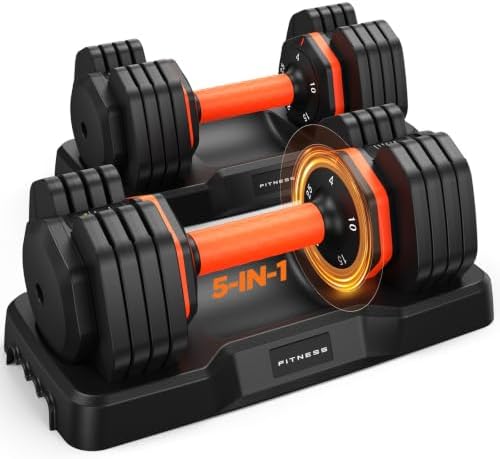
- adjustable dumbbell set
- 【1 Second Weights Adjustment】One hand, one second. Quickly switch between five weights from 4 to 25 lbs. Get more sets p…
- 【90% Cost & Space Saving】Replace 5 bulky dumbbell sets with just one adjustable dumbbell set. Less clutter, more workout…
2. An Adjustable Bench
A flat-only bench limits you to maybe half the movements you want. An adjustable one unlocks incline pressing, seated shoulder work, supported rows and step-ups. Check the weight rating and make sure it folds if storage is tight.
3. A Pull-Up Bar
Vertical pulling is the single most neglected pattern in home training, and it is the one that builds a back that looks like you train. A doorway bar costs very little. If your door frame will not take one, a wall-mounted bar is worth the drilling.
Cannot do a pull-up yet? That is what the next item is for.
4. Resistance Bands
Bands do three jobs well: they assist pull-ups while you build strength, they let you train pulling patterns without a cable machine, and they make an excellent warm-up tool for shoulders and hips. A set with varied tensions costs less than a single dumbbell.
5. A Kettlebell
One kettlebell, moderately heavy, covers swings, goblet squats, carries and Turkish get-ups. The swing in particular is the most time-efficient conditioning tool most people have access to. Start at 16kg if you are a man, 12kg if you are a woman, and adjust from there.
6. A Decent Mat
This sounds trivial until you try floor work on tile. A proper mat protects your joints, protects your floor, and quietly removes one more excuse not to train.
7. A Mirror Or A Phone Stand
Not vanity. Form feedback. Without a coach in the room, filming your sets is how you catch the rounded back on your deadlift before it catches you. A cheap phone tripod is one of the highest-value purchases on this list.

- Strong Magnetic Phone Holder: Hoyxun magnetic gym phone holder featuring six built-in N52 industrial-grade magnets, anti…
- Portable Phone Magnet Mount Design: This gym magnetic phone holder boasts a pocket-friendly design, making it easy to ca…
- 360° Adjustable Viewing: The magnetic phone mount for gym includes a 360° rotating ball joint, allowing you to find the …
The 5 Things To Skip At The Start
- Ab machines and rollers. Your core gets trained by carries, squats and hinges. Direct ab work is a garnish, not a main course.
- Fixed dumbbells in small increments. A rack of 5kg, 7.5kg and 10kg dumbbells eats your budget and your floor, then becomes useless in a season.
- Treadmills, at first. They are expensive, huge, and you already own a pair of shoes and a street outside.
- Vibration plates and EMS belts. No serious evidence they build strength or meaningfully change body composition.
- A full barbell rack, on day one. Barbells are excellent. They are also a later purchase once you know you will keep training and you have the space to do it safely.
Build It In Stages, Not All At Once
A sensible order looks like this:
- Month one: dumbbells, mat, bands. Train three days a week and prove to yourself you will show up.
- Month three: bench and pull-up bar. Your program can now cover every major pattern.
- Month six: kettlebell, and consider a barbell and rack if you have the space and the habit is genuinely stuck.
The staging matters. Buying everything upfront is how people end up with an expensive room they feel guilty walking past. Buying in stages means each purchase is earned by consistency you already demonstrated.
Equipment Will Not Write Your Program
This is the part most buying guides leave out. The gear is the easy problem. Knowing how many sets to do, when to add weight, and how to structure a week around your actual schedule is the hard problem, and no purchase solves it.
That is where a coach earns their keep. Our personalized fitness plans are built around the equipment you actually own, not a fantasy setup. If you have a bench and one pair of dumbbells, we will write you a program that progresses for months on exactly that.
Frequently Asked Questions
How much should a beginner spend on a home gym?
You can build a genuinely effective setup for the price of a few months of gym membership. Start with adjustable dumbbells, a mat and bands, then add pieces as your training habit proves itself.
Can you build muscle with only dumbbells?
Yes. Dumbbells cover every major movement pattern, and progressive overload is possible for years with an adjustable pair. Most beginners hit the limits of their consistency long before they hit the limits of their dumbbells.
How much space do I need for a home gym?
About two metres by two metres is enough for dumbbell and bodyweight training. You need room to lie down with arms extended and to lunge in one direction. A barbell setup needs considerably more.
Is a home gym better than a commercial gym?
It depends entirely on what stops you from training. If your barrier is travel time, home wins. If your barrier is motivation and you feed off other people, a gym floor wins. Be honest about which one you are.
Not sure what to buy first for your goals and your space? Talk to one of our coaches and we will tell you what you need, and just as usefully, what you do not.