
As an Amazon Associate I earn from qualifying purchases
You don’t need a spare bedroom, a garage, or a huge pile of weights to build a useful home gym.
In fact, one of the easiest ways to waste money is to start buying equipment before deciding what you actually need. A few months later, the room is crowded, half of the equipment is collecting dust, and your “home gym” has turned into a storage area.
A small-space gym needs a different approach.
The best equipment is compact, easy to store, useful for multiple exercises, and good enough that you won’t feel the need to replace it after a few months.
So instead of filling this list with 10 random fitness gadgets, we’re focusing on equipment that can genuinely earn its place in a small home gym.
Amazon affiliate disclosure: As an Amazon Associate I earn from qualifying purchases. Prices and availability may change.
1. Adjustable Dumbbells
If you only have room for one serious piece of strength equipment, adjustable dumbbells are a very strong place to start.
A traditional dumbbell set can take up an entire corner of a room. Adjustable dumbbells give you multiple weight options without needing a full rack.
That matters even more when you’re working out in a bedroom, apartment, or small home office.
You can use them for:
- Goblet squats
- Romanian deadlifts
- Dumbbell rows
- Shoulder presses
- Chest presses
- Lunges
- Biceps curls
- Triceps extensions
The main thing to look for is a weight range that gives you enough room to progress. Buying a set that feels challenging today but becomes too light six months from now isn’t really saving money.

- QUICK ADJUSTMENT DIALS: Switch between weight settings with a quick twist of the dials, from 5 to 52.5 pounds per dumbbe…
- SPACE-SAVING DESIGN: Get more workout in less space by replacing 15 separate weights with a single, all-in-one set.
- PREMIUM METAL COMPONENTS: Reinforced with durable metal plates and a locking system to keep weights in-place.
2. Resistance Bands
Resistance bands take almost no storage space, which is exactly what you want in a small gym.
A decent set can be useful for warm-ups, accessory exercises, upper-body work, lower-body exercises, and days when you don’t feel like moving heavy weights around.
They’re also useful when you’re travelling. A set of bands can fit inside a small bag, so your workout doesn’t have to stop just because you’re away from home.
One important tip: don’t buy a band set just because the package contains a lot of pieces. Pay attention to the resistance levels and whether the set actually suits the exercises you plan to do.
3. A Foldable Adjustable Bench
A bench is one of those purchases that you might not appreciate until you start using one.
With a good adjustable bench, your dumbbells become much more versatile. You can do incline presses, seated shoulder presses, supported rows, split squats, step-ups and a lot more.
The key word here is foldable.
For a small home gym, there’s little reason to buy a huge commercial-style bench that permanently occupies half your room. Look for one that is sturdy during training but can be moved against a wall when you’re finished.
4. A Doorway Pull-Up Bar
Pull-ups are one of the simplest ways to train your back and upper body without a large piece of equipment.
A doorway pull-up bar can give you access to pull-ups, chin-ups and several other bodyweight movements while taking up almost no floor space.
Before buying one, measure your doorway and check the manufacturer’s installation requirements. Not every pull-up bar fits every door frame.
And don’t treat the advertised weight capacity as something to ignore. Your safety matters more than saving a few dollars.
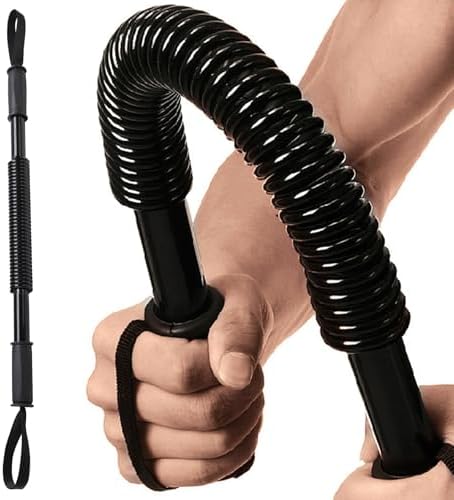
- Safer Grip, Better Control – High-tension spring bars can snap back if your hands slip. This CALCHELE power twister bar …
- Built for Steady Tension – The durable carbon steel spring delivers firm resistance for bending reps, chest squeezes, an…
- Pick Your Perfect Resistance – Choose from 20-44LBS/20-66 LBS/20-110 LBS/20-132 LBS, Start with 20 lb for beginners, cho…
5. A Good Exercise Mat
This is probably the least exciting item on the list.
It’s also one you’ll use constantly.
A proper exercise mat gives you a more comfortable surface for floor exercises and can help protect your flooring from sweat, movement and occasional equipment contact.
It’s useful for:
- Push-ups
- Planks
- Sit-ups
- Mobility work
- Stretching
- Core exercises
- Bodyweight workouts
You don’t necessarily need the thickest mat available. For most people, a durable mat with enough cushioning and a surface that doesn’t slide around is more useful than a massive premium mat.

- THICK 1/2-INCH MAT + KNEE PAD – High-density NBR foam provides comfortable full-body cushioning between you and hard flo…
- VERSATILE YOGA & EXERCISE MAT – The 68″ x 24″ cushioned surface provides plenty of room for yoga, Pilates, stretching, s…
- LATEX-FREE NBR FOAM & EASY CARE – Made from high-density NBR foam without latex for easier everyday care. The low-mainte…
6. An Ab Wheel
Here’s one small piece of equipment that can do a lot without taking up much room.
An ab wheel gives you a simple way to train your core with progressive rollout variations.
But there’s a catch: it is not necessarily a beginner-friendly exercise.
If you’re new to ab-wheel rollouts, start with a range of motion you can control instead of trying to roll as far as possible on your first attempt. A short, controlled rollout is far more useful than a sloppy full extension.
Once you become stronger, you can gradually increase the range.
7. A Jump Rope
A jump rope is cheap, tiny and surprisingly useful.
You can use it for a quick conditioning session, add it between strength-training sets, or simply use it when you want something different from your usual workout.
And when you’re finished?
Put it in a drawer.
That’s hard to beat in a small home gym.
The only thing to keep in mind is your training surface and surroundings. If you’re jumping indoors, make sure you have enough ceiling height and floor space to move comfortably.
8. Push-Up Handles
You don’t need push-up handles to do push-ups.
But they’re a useful little upgrade if regular floor push-ups bother your wrists or you simply prefer using handles.
They’re also extremely easy to store.
This is exactly the type of purchase that makes sense in a small gym: inexpensive, compact and easy to put away when you’re done.
Look for handles with a stable base and non-slip contact points rather than choosing purely based on appearance.
9. A Kettlebell
A kettlebell can be useful, but I wouldn’t automatically make it your first purchase.
If you already have adjustable dumbbells, resistance bands and a bench, you can cover a huge number of movements without adding another large piece of equipment.
A kettlebell becomes more interesting when you specifically want to train movements such as:
- Swings
- Goblet squats
- Carries
- Rows
- Presses
- Turkish get-ups
For a small-space gym, one versatile kettlebell is usually more sensible than buying several different sizes immediately.
10. A Small Storage Solution
This may sound like a strange addition to a gym equipment list, but storage is what keeps a small gym usable.
You don’t need a giant commercial rack.
A small dumbbell tray, wall-mounted storage solution, resistance-band organizer, or simple equipment stand can make the room feel dramatically less cluttered.
And there is another benefit: when your equipment has a specific place to go, you’re more likely to put it away.
A small gym works best when you can go from “workout mode” back to “normal room” in a couple of minutes.
What Should You Buy First?
This is where I would avoid copying the usual “buy everything” advice.
You probably don’t need all 10 pieces.
For a very small space, I’d build the gym in stages.
Stage 1: Start with the basics
Get:
Adjustable dumbbells + resistance bands + exercise mat
That combination already gives you a huge number of exercise options.
Stage 2: Make the dumbbells more useful
Add:
A foldable adjustable bench
Now you have many more pressing, rowing and lower-body options without dramatically increasing the amount of space you need.
Stage 3: Add bodyweight and conditioning equipment
Consider:
Pull-up bar + jump rope + ab wheel
These are relatively small purchases that expand what you can do without turning the room into a warehouse.
Stage 4: Buy only what solves a real problem
Kettlebells, push-up handles, extra accessories and storage equipment can come later.
There’s no prize for owning the most equipment.
The goal is to build a setup you’ll actually use.
What I Would Skip in a Small Home Gym
Not every piece of “must-have” gym equipment deserves your money.
I’d think twice before buying large machines that only perform one or two exercises, oversized equipment that is difficult to store, or cheap gadgets that promise to replace an entire gym.
A good rule is simple:
If you can only think of one exercise to do with a piece of equipment, ask yourself whether it deserves permanent space in your home.
There are exceptions, of course. If a specific machine is exactly what you need and you have the space for it, that’s different.
But for most people building a gym in a small room, versatility matters.
How Much Space Do You Actually Need?
Probably less than you think.
The equipment itself isn’t usually the biggest problem. The bigger issue is having nowhere to put it when you’re not using it.
A pair of adjustable dumbbells can sit against a wall. Bands can live in a drawer. A jump rope can hang from a hook. An ab wheel can slide under a desk or shelf. A foldable bench can be stored vertically.
That means your gym doesn’t necessarily need to look like a gym all day.
And that’s the whole point.
You want a setup that appears when you need it and disappears when you don’t.
Final Thoughts
A small home gym isn’t supposed to compete with a commercial gym.
It just needs to help you train consistently.
Start with equipment that gives you the most exercise options for the least amount of space. Buy slowly. Upgrade when your training actually requires it.
For most people, that means starting with adjustable dumbbells, resistance bands and a good exercise mat, then adding a foldable bench and pull-up bar as needed.
You don’t need ten pieces of equipment to get started.
You need a setup that makes the next workout easy to do.
And honestly, that’s a much better home gym to have.